The headline change: ¥5 million is no longer enough
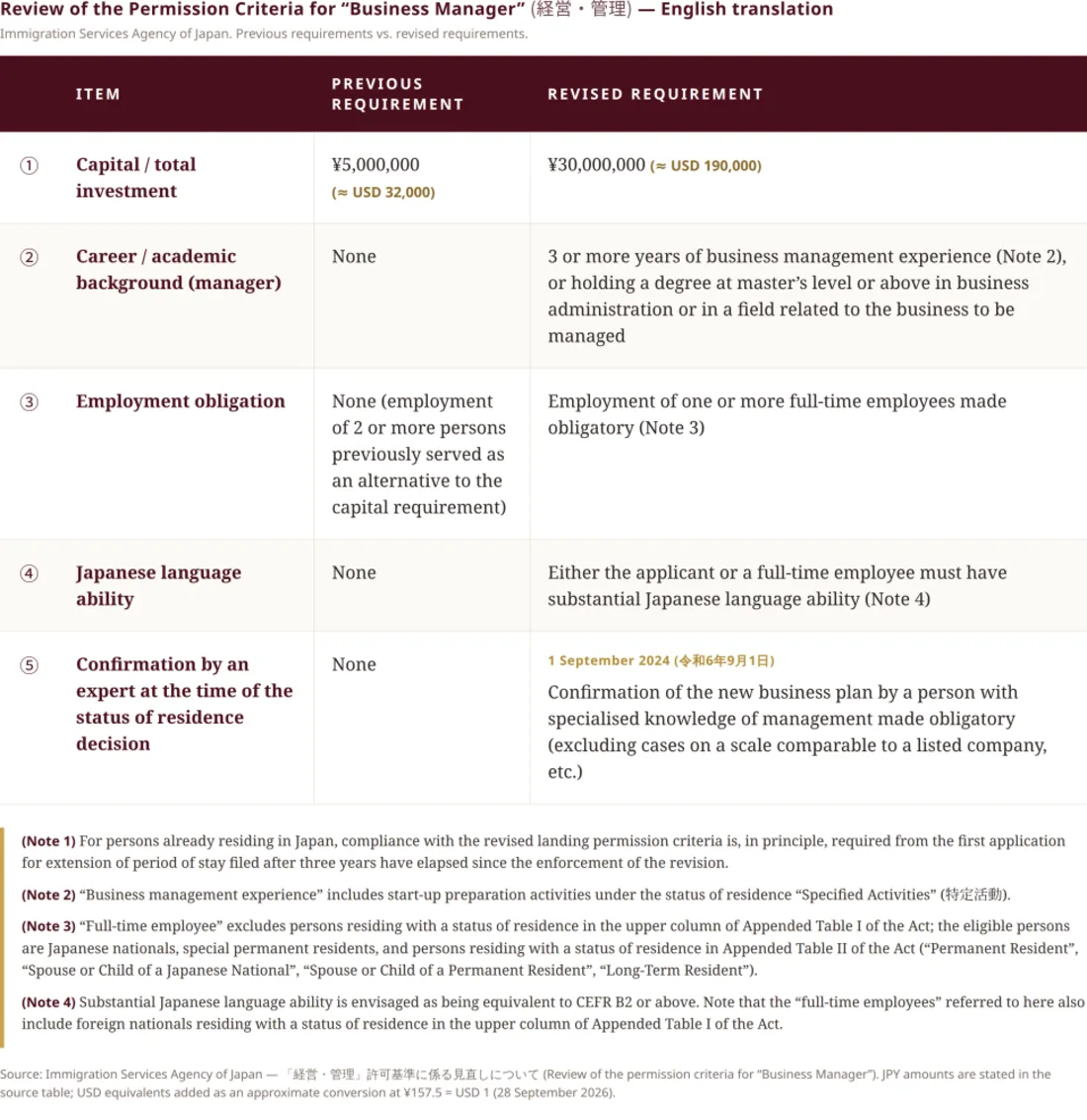
If you were planning to qualify for Japan's Business Manager Visa (経営・管理) with the long-standing ¥5,000,000 (approx. USD 32,000) capital minimum, that figure is out of date. On 16 October 2025, the Immigration Services Agency of Japan amended the ministerial ordinance governing this visa category, raising the minimum capital or investment requirement to ¥30,000,000 (approx. USD 190,000 at ¥157.5/USD) — a sixfold increase — and adding four further requirements on top of it.
This is the single most consequential immigration change for foreign entrepreneurs and property investors in years, and a large amount of English-language coverage still cites the old ¥5 million figure. Here is what is actually required, as of today.
The five requirements now in force
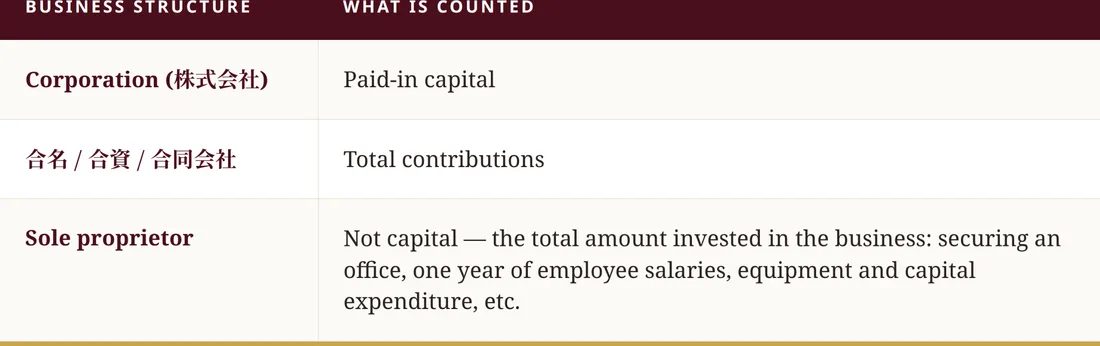
1. Capital or investment of at least ¥30,000,000. For a corporation, this is paid-in capital. For a sole proprietor, the Immigration Services Agency has explicitly clarified that the test is total amount invested into the business, not a capital figure — a widely repeated claim that sole proprietors must hold ¥30 million in capital is incorrect.
2. At least one full-time employee — but the pool of who counts is narrow. It is limited to Japanese nationals, special permanent residents, and holders of Table II statuses (Permanent Resident, Spouse of a Japanese National, Spouse of a Permanent Resident, Long-Term Resident). A foreign employee on a standard work visa — Engineer, Specialist in Humanities, International Services — does not satisfy this requirement, even if they work full-time.
3. Japanese language ability of B2 or above (under the Framework of Reference for Japanese Language Education), held by you or a full-time employee — evidenced by JLPT N2+, BJT 400+, 20+ years of residence, or graduation from a Japanese university or high school. Note the asymmetry: for this requirement, "full-time employee" is defined more broadly and does include foreign nationals on Table I status — so a foreign employee can supply the language ability, even though they cannot supply the headcount above.
4. Career or education — a doctorate, master's, or professional degree related to business management (foreign degrees count), or three or more years of business management experience. Time spent in Japan on startup-preparation activities under the 特定活動 status counts toward the three years.
5. Professional sign-off on your business plan — it must now be reviewed and confirmed as specific, rational, and feasible by a 中小企業診断士 (SME management consultant), 公認会計士 (certified public accountant), or 税理士 (licensed tax accountant). A self-prepared business plan is no longer sufficient, and this is a recurring cost, not a one-off.
Two operational rules that quietly disqualify a business
Beyond the five formal requirements, the Agency's guidance sets positions that are just as decisive in practice. First, using your home as your office is, in principle, not permitted — you must secure an office commensurate with the scale of operations, and a spare room in a property you bought will not satisfy this. Second, outsourcing the substance of the business is not permitted — where your actual management activity cannot be sufficiently recognized because operations are fully outsourced to a third party, the Agency will not treat you as conducting Business Manager activity. Running a minpaku entirely through an operator, as a passive owner, is the example most often cited.
The three-year grace period — and the trap inside it
If you already hold a Business Manager Visa, renewal applications filed before 16 October 2028 will be assessed taking your business condition and prospects into account, even if you do not yet meet the new criteria. But this is widely misread in two ways. First, existing holders who cannot reach ¥30 million within three years will not automatically be forced to leave Japan — where the business is sound, taxes are current, and there is a credible prospect of meeting the criteria, the decision is comprehensive, not a hard cutoff. Second, this is not a three-year waiting room: a management-expert evaluation of your business may be requested during the grace period itself, and from 16 October 2028 the new criteria become the baseline for everyone.
There is no grace period at all, however, for permanent residence. From the effective date, permanent residence will not be granted from Business Manager or Highly Skilled Professional routes premised on Business Manager activity unless you meet the revised criteria now — regardless of how long you have held the visa.
Renewal now audits compliance, not just capital
At renewal, the Agency checks labour insurance enrolment and payment, social insurance enrolment and payment, and the full set of applicable national and local taxes — not just that you have money in the bank. Unexplained long absences from Japan are now treated as an absence of genuine activity and are a ground for refusal. For investors who intended to hold the visa while living mostly elsewhere, this is a structural problem that the new rules were specifically designed to address, not an administrative oversight that can be papered over.
What this means if your plan was to buy property and operate it
If you are buying Japanese real estate purely for personal use — a holiday home you visit on short-stay or visa-exempt entry — none of this changes anything; there remains no nationality restriction on owning freehold property in Japan. But if your plan depended on holding Business Manager status to live in Japan and run a rental, minpaku, or hospitality operation from the property, the cost and structure have changed fundamentally: ¥30 million of capital or genuine investment, a dedicated commercial office separate from where you live, a qualifying full-time employee on payroll, N2-level Japanese ability somewhere in the business, the right career background, a professionally reviewed business plan, and real hands-on management. That is a different business, not a different form — and for many investors, operating through a Japanese corporation with local management, or holding the asset while engaging a domestic operator, is now the more realistic route to the same economic outcome.
How we help
Because this reform touches company structure, employment, language requirements, and the business plan itself all at once, the right sequence depends entirely on your specific facts — whether you already hold the visa and are planning a renewal, or you are structuring a new application from scratch. Our Incorporation & Full Business Setup service, coordinated by a licensed Japanese Judicial Scrivener, works through the corporate structure, registered address, and banking preparation that sit underneath any visa application; for the immigration filing itself, we work alongside licensed administrative scriveners (行政書士) who handle the application. Book an advisory call to map out which of the five requirements you already satisfy, and what the realistic path looks like from here.