No, there is no nationality ban — and there has never been one
We've been getting a version of the same question for months: "I heard Japan is banning foreigners from buying land — is that true?" It is not. Japan has never restricted land ownership by nationality, and it does not do so today. A non-resident with no Japanese visa can still buy land, houses, and apartments outright, on exactly the same terms as a Japanese citizen — no approval step, no minimum residency, no nationality condition.
What is true is that 2026 is the year Japan switched on the plumbing to find out who actually owns its land, and the year its government began drafting security-based rules on future acquisitions. The distinction between measuring and restricting is the whole story — and most English-language coverage has blurred it.
The five rules that actually touch a foreign buyer
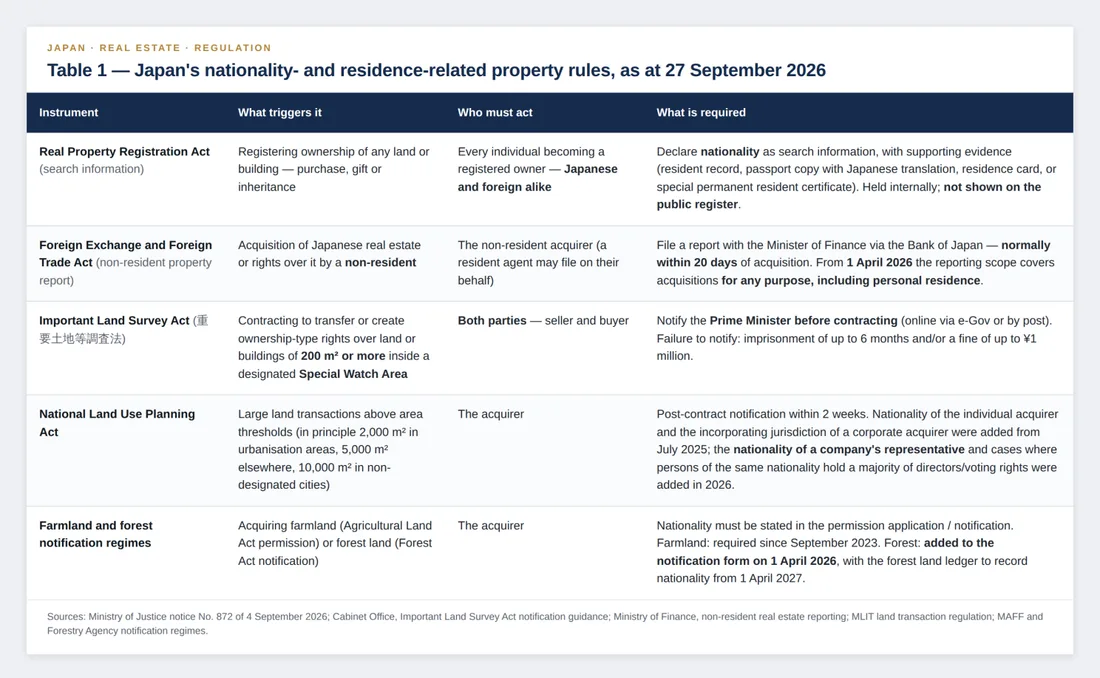
Rather than chase headlines, track these five instruments — between them they cover almost every scenario where nationality or residence becomes relevant: (1) nationality declaration at property registration from 5 October 2026; (2) the Foreign Exchange and Foreign Trade Act's non-resident reporting requirement; (3) the inbound direct investment screening regime, relevant if you acquire a company rather than land directly; (4) the Important Land Survey Act's pre-contract notification for designated Special Watch Areas; and (5) separate nationality-disclosure notification for farmland and forest acquisitions.
Two structural points are worth holding onto. First, the Foreign Exchange Act keys off residence, not nationality — a Japanese national living abroad who buys a Tokyo apartment is in scope, while a foreign national living in Tokyo buying the same apartment is not. Second, the Important Land Survey Act keys off location and size, not who is buying — a ¥2 billion apartment in a Special Watch Area needs a pre-contract notification, and so does an inexpensive adjoining 250m² plot, regardless of the buyer's passport.
What actually changes on 5 October 2026: nationality on the register
This is the change that generated the alarming headlines, and it is the mildest of the group. Since 2025, ownership-registration applications have required search information about the new owner — name, address, date of birth. From 5 October 2026, nationality is added to that list, for every individual who becomes a registered owner, Japanese nationals included.
What it is not: a restriction, an approval step, a screening process, or a change in ownership rights or tax treatment, and it is not retroactive — existing owners are unaffected. It is also not published on the public register anyone can obtain a copy of; it sits in an internal administrative file used for cross-agency data sharing. For a buyer, the practical effect is one additional supporting document at closing — a passport copy with Japanese translation, which non-resident buyers will typically already be providing for other steps in the transaction.
The Foreign Exchange Act: the layer that actually bites
If you take away one technical point from this guide, take this: the operative distinction in Japanese real-estate regulation is residence, not citizenship. The Foreign Exchange and Foreign Trade Act has long required non-residents acquiring Japanese real estate to file a report with the Ministry of Finance. From 1 April 2026, the scope widened to cover acquisitions for any purpose — including personal residential use — with the report due within 20 days of acquisition, payable by the non-resident buyer or a resident agent acting for them.
A separate, more consequential layer applies if you acquire a company rather than land directly: buying shares in an unlisted Japanese company operating in a designated sector can require prior notification with no minimum threshold at all, plus a review period that normally runs 30 days. Deal timetables that assume straightforward asset-purchase treatment can slip badly if the structure is actually a share acquisition.
What the farmland and forest numbers actually show
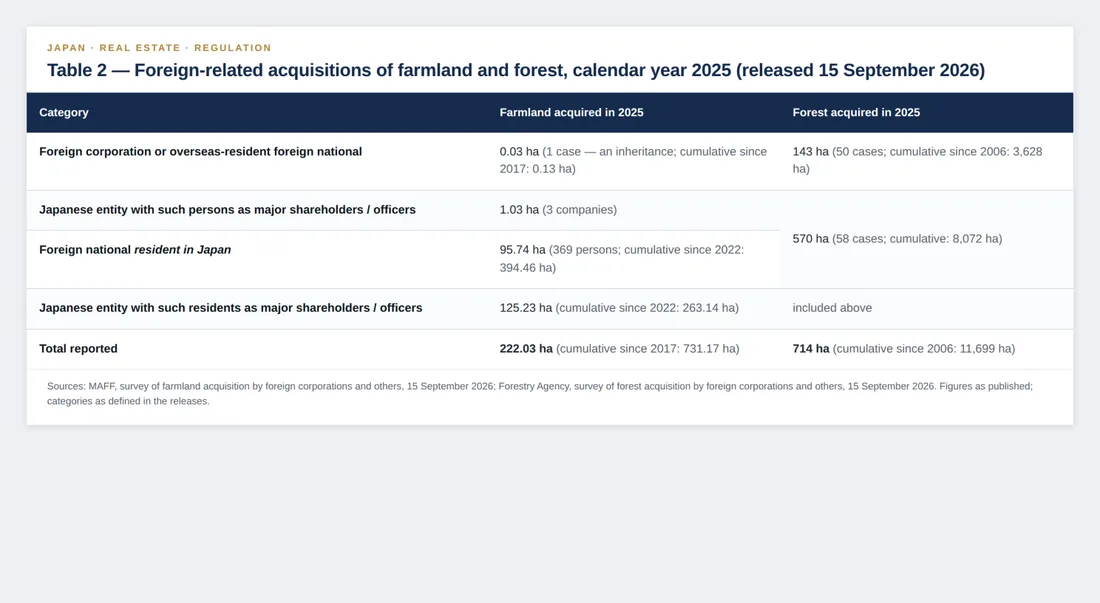
Annual government surveys published in September 2026 give the most granular public figures available on foreign-related land acquisition — and they are routinely misread. The genuinely offshore share is tiny: foreign corporations and overseas residents acquired just 0.03 hectares of farmland in all of 2025 — a single inherited plot — and 143 hectares of forest across 50 cases nationwide. The forest figure is concentrated, not diffuse, dominated by the Niseko–Rusutsu–Kutchan resort corridor in Hokkaido, driven by resort real estate investment rather than strategic land banking. Both government releases are explicit that no cases of forest acquisition for water intake or groundwater extraction have been reported.
The one rule with real teeth — and it is about location, not nationality
The Important Land Survey Act, fully in force since 2022, is the only instrument in this area carrying criminal penalties — and it applies entirely by geography, not nationality. Inside a designated Special Watch Area (roughly a 1km radius around defense facilities, nuclear installations, and specified airports or border islands), both the seller and the buyer must notify the Prime Minister's office before contracting, for land or buildings of 200m² or more. The penalty for failing to file or filing falsely is up to six months' imprisonment and/or a ¥1 million fine — and the same rule applies to a Japanese developer, a Japanese pension fund, and a foreign family office alike. Zone boundaries can be checked on the Cabinet Office's Important Land Web Map, and designations are added periodically, so a zone check belongs at the start of due diligence, not the end.
What is still only being drafted
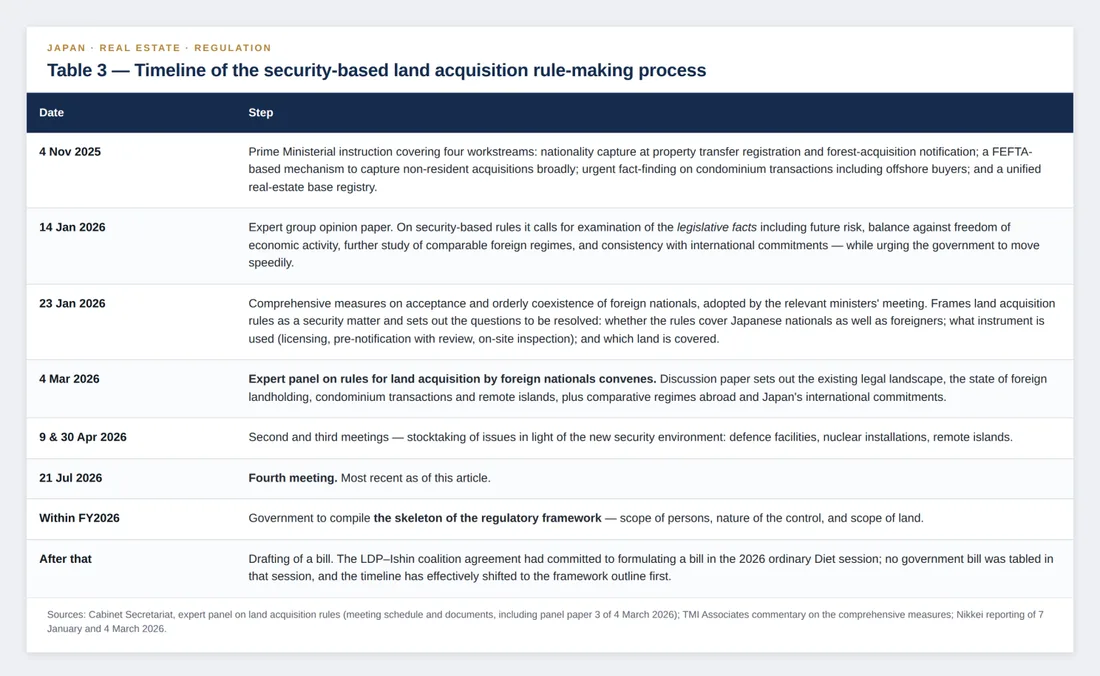
As of today, no statute restricting land acquisition on security grounds has been enacted or even formally introduced — what exists is a government expert panel working to a defined timetable, with its fourth meeting held in July 2026 and a regulatory skeleton due within the current fiscal year, legislation to follow after that. The panel's own working language consistently frames the open question as whether any future rule should cover everyone regardless of nationality or be limited to foreign nationals — and reporting indicates the foreigner-only option has run into difficulty on international-commitment grounds. If that holds, expect any eventual security-based regime to be written nationality-neutral, layered on the Important Land Survey Act template rather than replacing it.
How we help
The real risk in a Japanese land purchase today is operational, not legal: extra documentation, a 20-day reporting clock, a zone check against the Special Watch Area map, and — for corporate acquisitions — a screening analysis of whether the target counts as a share purchase under the investment-screening regime. Our Real Estate Advisory retainer handles exactly this: due diligence and zone checks before you commit, title registration handled directly by our licensed Judicial Scrivener, and the nationality and FEFTA documentation prepared correctly the first time — so you have one bilingual point of contact instead of coordinating the registry, the bank, and the reporting requirements separately from overseas.