The question that should make every sales leader uncomfortable
Buyer behavior has changed faster than most sales playbooks. People no longer answer calls from unfamiliar numbers — AI screens first and summarizes afterward. Cold emails get triaged by an inbox assistant before a human ever reads them. On LinkedIn, most SDR outreach is read-and-ignored, or simply unread. And when we honestly count how many of our own purchase decisions actually started with a cold outreach, the number is close to zero.
None of this means pipeline generation is dead. It means the mechanics of what actually works have shifted — and the data, once you line it up, tells a surprisingly consistent story.
The baseline fact: most buyers decide before sales is ever involved
94% of buyers have already settled on a preferred vendor before they engage with sales, and 77% of the time they buy from that pre-contact favorite (6sense, 4,000+ respondents, 2025 Buyer Experience Report). Of the total time a buyer spends on a purchase, only 17% is spent meeting with potential suppliers at all (Gartner). And yet — this is the part that matters for anyone running a sales team — 67% of buyers say they would prefer a buying experience with no sales rep involved at all, while 69% say they want to validate AI-generated information together with a sales rep. The cold call and the sales conversation have not been replaced; they have been repositioned from first contact to the moment of validation, where quality now matters far more than volume.
Cold calling by the numbers: who, when, and which number
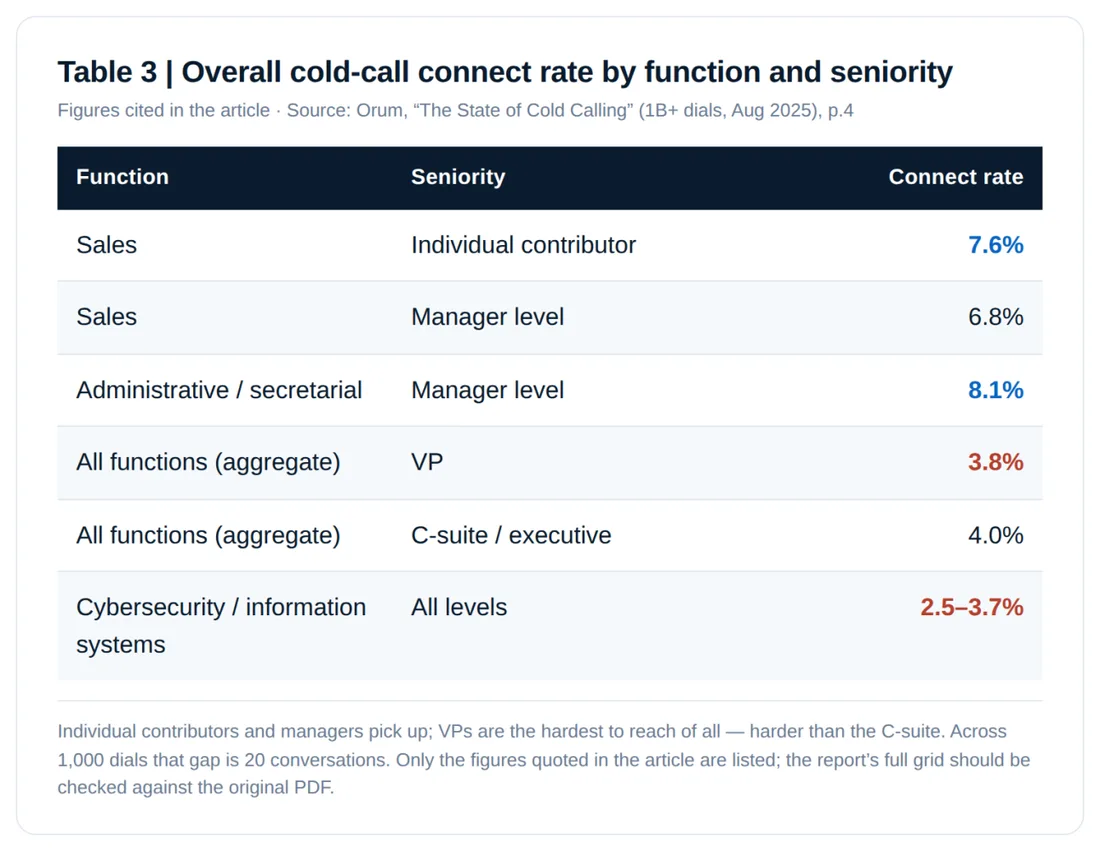
Orum's analysis of over one billion measured cold calls (August 2025) is the most granular public dataset on this available, and it reframes 'cold calling is dead' entirely. Connect rates differ sharply by function and seniority: sales individual contributors connect at 7.6%, sales managers at 6.8%, administrative/secretarial managers at 8.1% — but VPs connect at only 3.8%, lower than the C-suite at 4.0%, and cybersecurity/information-systems roles answer least of all, at 2.5–3.7%. The practical design that follows: work individual contributors and managers first to collect pain points and evidence, then elevate to VPs and the C-suite — which lines up with Gartner's finding that a typical buying group spans 5 to 16 people across up to 4 functions.
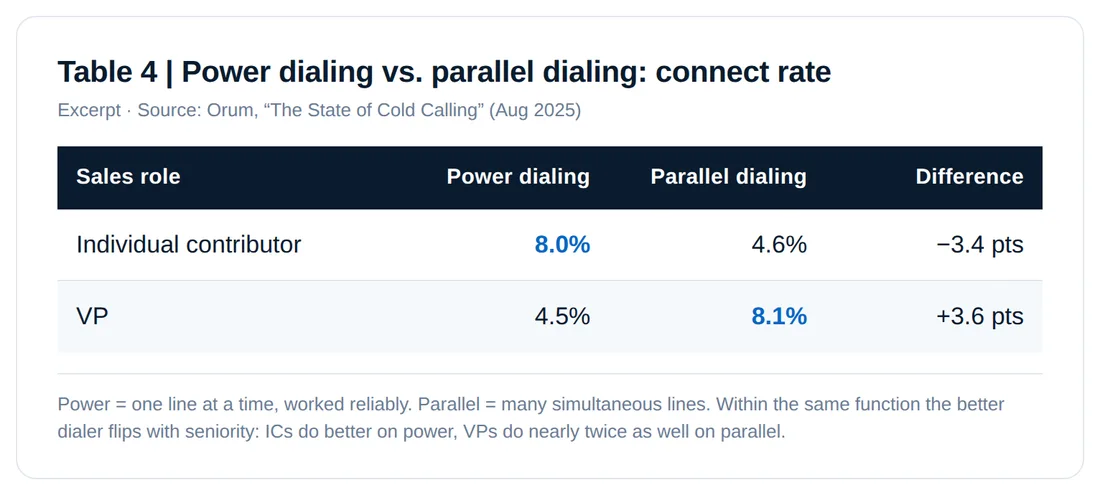
Dialing method itself reverses by seniority. On power dialing (one line at a time), individual contributors connect at 8.0% versus 4.6% on parallel dialing; for VPs it flips — 4.5% on power versus 8.1% on parallel, nearly double. The same function needs a different dialing method depending on who is on the other end.
The single biggest lever: a number's own history
Orum has dialed over 60% of the numbers in its registry and holds connection history on all of them. 'Hot numbers' — numbers with a proven pickup history — connect at 24.7% for finance VPs, 24.4% for sales VPs, and 24.2% for administrative/secretarial C-suite — three to five times the normal connect rate, and the effect holds at every seniority level, not just individual contributors. The conclusion: it is not that VPs don't connect, it is that the risk attached to a given number is high. Number reputation management is a strategic variable on a par with account-based marketing and target selection, and basic hygiene compounds — in a separate Orum analysis of 7.8 million calls, leaving a voicemail after the first cold call raised the subsequent connect rate by 25.8%.
AEO and GEO: optimizing to be built into the answer, not just to rank for it
The buying behavior described at the top of this guide — buyers asking ChatGPT or Gemini before they ever talk to a seller — is why AI engine optimization (AEO) and generative engine optimization (GEO) have become a priority channel rather than an experiment. AEO means creating a state where your company is cited inside AI assistants' answers; GEO means organizing your content, facts, and sources so that as a generative AI assembles an answer, your company appears as a candidate and is described correctly. Conventional SEO optimizes to rank in search results; AEO and GEO optimize to be built into the answer itself — which is precisely why a company's own published content and source material matter more now, not less.
This is also where human verification compounds the effect: alongside AI search, buyers check with peers — 'what's everyone else actually doing?' — and that real-world verification has an outsized effect on the purchase decision. One sentence from a trusted customer moves a deal further than a hundred sales pitches, and it cannot be manufactured as a curated 'customer voices' page — it has to come from a real person, in the real world.
The priority order the data actually supports
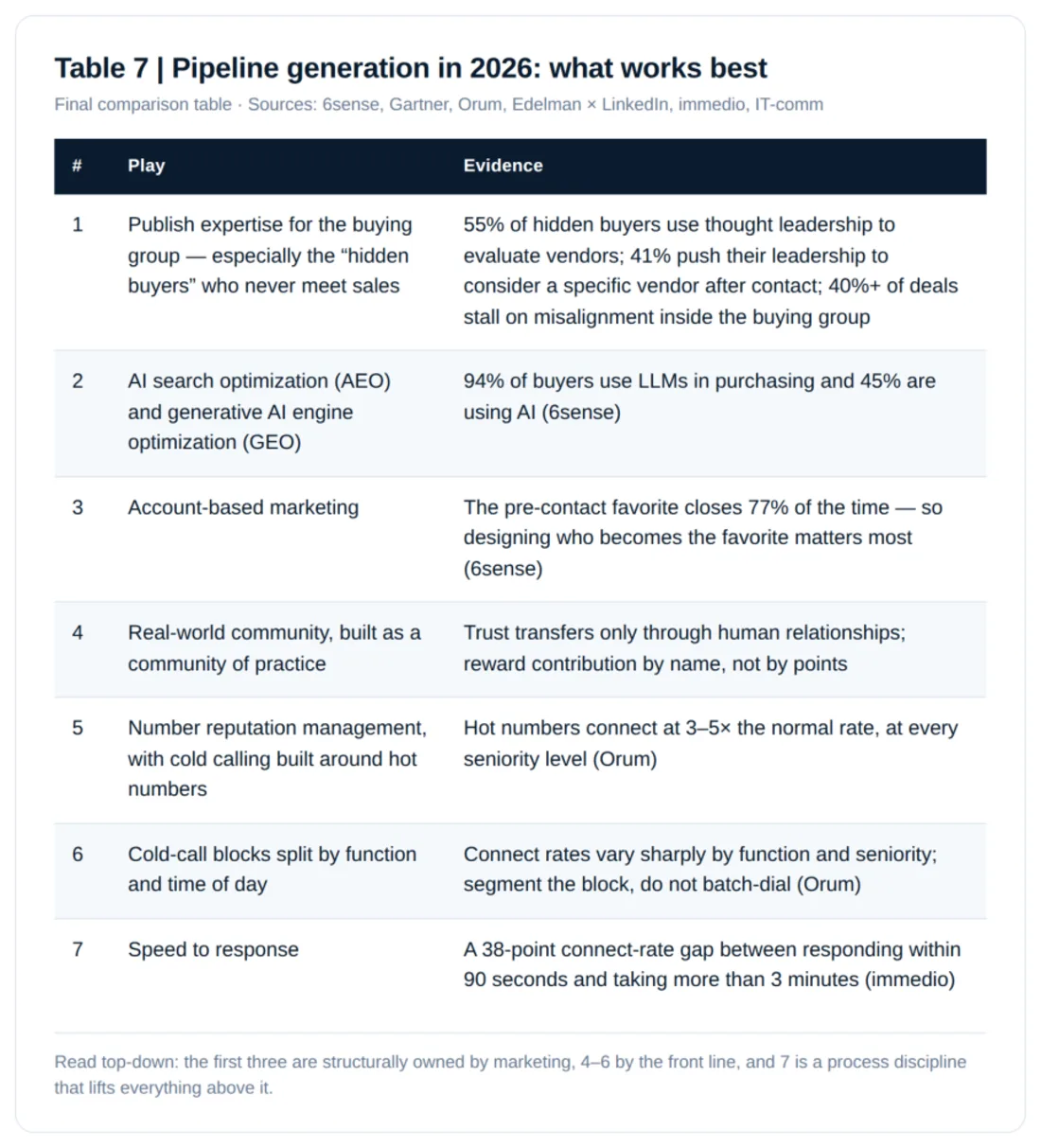
1. Publish specialized expertise for the whole buying group — especially the "hidden buyers" who never meet sales directly. 55% of hidden buyers use thought leadership to evaluate vendors, and 41% push their leadership to consider a specific vendor after contact; more than 40% of deals stall on misalignment inside the buying group (Edelman × LinkedIn).
2. AI engine optimization and generative engine optimization — 94% of buyers use large language models somewhere in the purchase process, and 45% are already actively using AI tools for it (6sense).
3. Account-based marketing. If the pre-contact favorite closes 77% of the time, designing who becomes the favorite matters more than almost anything else that happens after contact.
4. Real-world community — designed as a community of practice, not a gathering of fans, with contribution rewarded by name rather than by points.
5. Number reputation management, with cold calling built around hot numbers rather than cold lists.
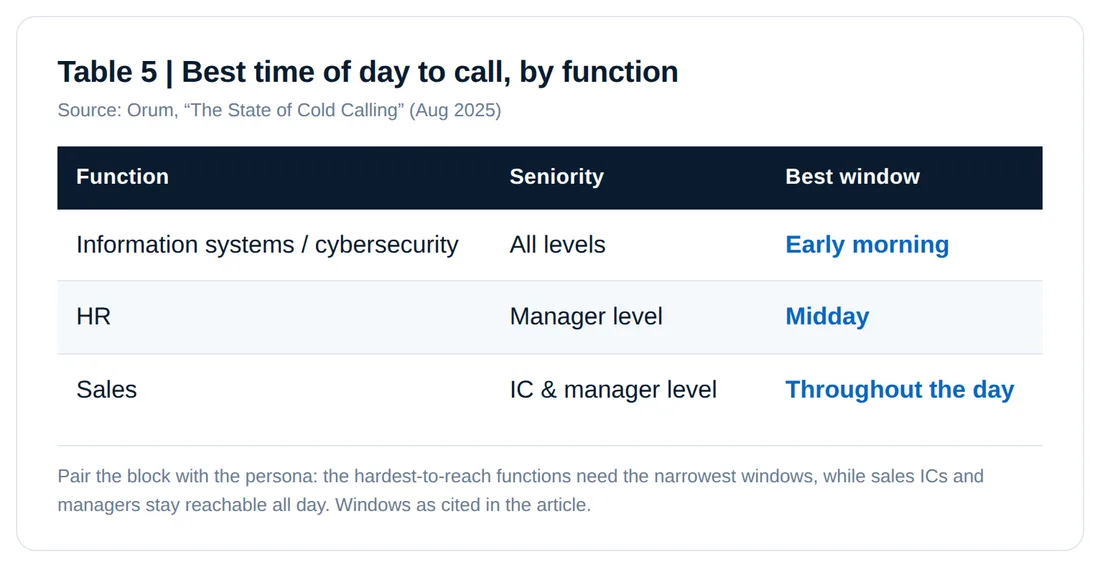
6. Cold-call blocks segmented by function and time of day — information systems early morning, HR managers at midday, sales ICs and managers throughout the day.
7. Speed to response — there is a 38-point gap in connect rate between responding within 90 seconds and taking more than three minutes (immedio).
The Japan lens: the same question, with domestic data
The pattern above holds, and in some respects is sharper, in Japan's enterprise market. In One Marketing's survey of 600 buyers, 85% had effectively pre-selected their vendor before the first meeting; HubSpot Japan's 2026 survey of 1,573 respondents found 63.5% had already reached a shortlist before contacting a seller, and over half took more than a month to decide. Japanese buying groups are also larger than most Western sales teams plan for — averaging 5.6 people for deals under ¥3 million, 14.4 in the mid-price band, and 18.3 at the high end, with 58.5% of ¥5 million+ software/SaaS deals involving seven or more people in the decision (IDEATECH × Demajen Research).
Japanese buyers use generative AI in their purchase process at rates that now rival the West: 86.4% of companies use generative AI for business purposes, and the fastest-growing information-gathering behavior over the past two to three years is using generative AI and AI search, at 33.5% adoption. But the most trusted information sources remain unambiguously human: clear pricing and contract terms (60.6%), individual explanations from a sales rep (59.8%), and case studies (57.0%) all rank above generative AI summaries, which finished last of ten listed sources at 37.8% (Web-Tantosha Forum). Measured phone data tells the same story from the other direction: Japan's 2026 Inside Sales White Paper reports an average cold-call connect rate of 26.6%, with evaluation metrics shifting industry-wide from call volume to conversation quality.
How this applies if you are entering or selling into the Japan market
Everything above compounds a point we make constantly to clients testing Japan market entry: a cold call or cold email from an unfamiliar overseas company, in English, carries structurally less weight here than the same outreach in many Western markets — not because the product is weaker, but because Japanese buying groups are larger, slower to decide, and rely more heavily on a credible local introduction before commercial terms are seriously discussed. The research above is the data version of what our GTM / Market Entry Advisory work tests directly: whether your specific product resonates with Japanese enterprise buyers, and what combination of warm introduction, thought leadership, and number reputation actually opens a conversation here — before you commit to a local hire built on assumptions rather than evidence.
How we help
Our GTM / Market Entry Advisory service works as your Japan sales team on the ground before you commit to a local hire — testing product-market fit directly with enterprise buyers, opening doors through an established local network, and running sales conversations in Japanese or English as the situation requires. When the data shows confirmed demand and enough pipeline volume to justify a dedicated team, we support that direct-hire transition too.